
A house, carried forward · 1776–today
One house.
Many lives.
A minister’s home and a place of learning. A witness to a changing Gettysburg. A building restored, adapted and welcomed into another century. Follow the people, the details and the chapters that make Dobbin House more than a single moment in history.
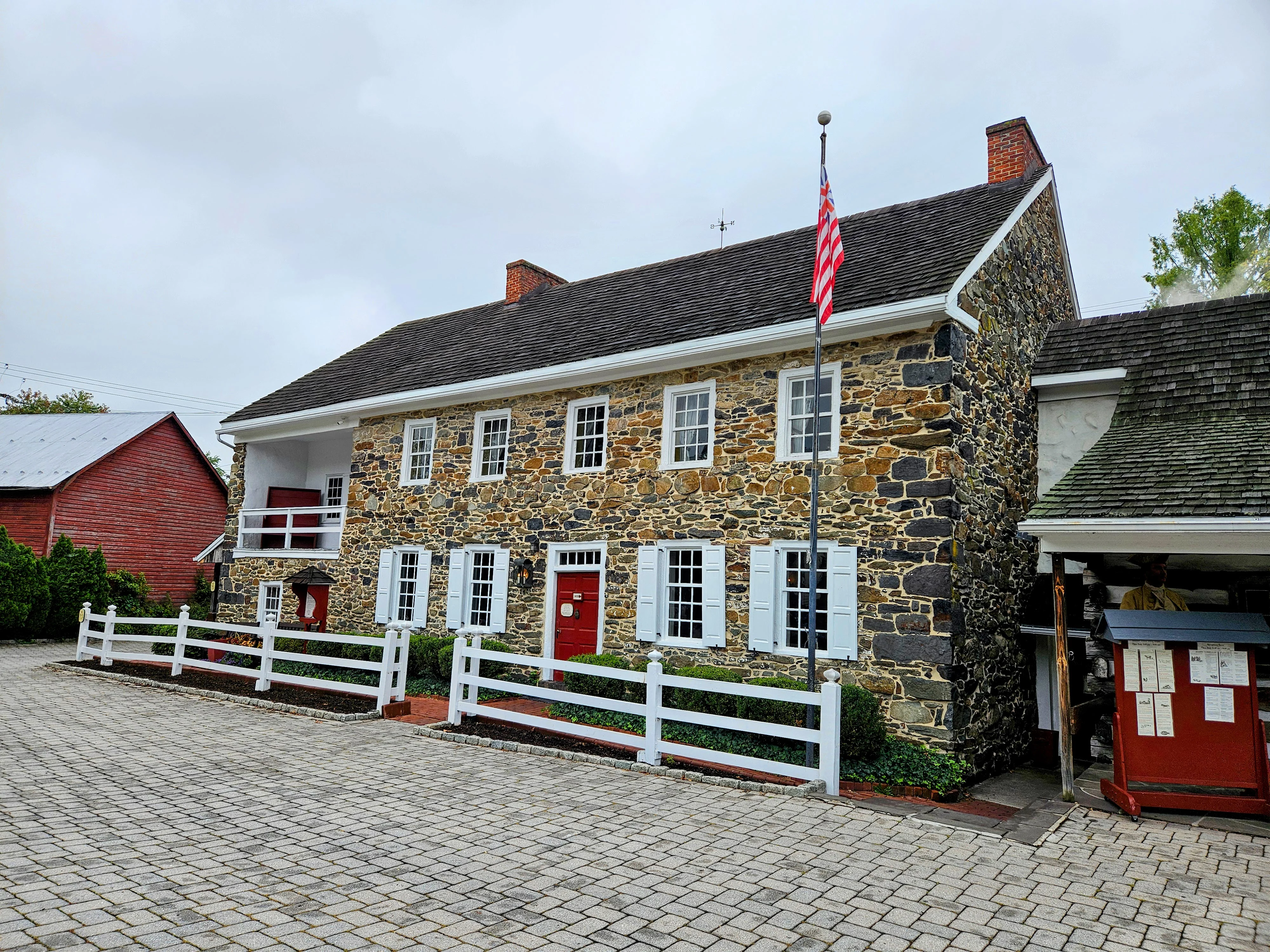
Dobbin House · photograph by Upstateherd, September 2024 · CC BY-SA 4.0.
01 / 1742–1800
A new life.
A growing community.
1776
A house built in the year of American independence. A town and county still taking shape around it.
Before Gettysburg became a name known around the world, Alexander and Isabella Dobbin were making a life here. He was a minister and teacher from Ireland; she was Isabella Gamble before their marriage. Their household would become part of the educational, religious and domestic life of a community still taking shape.
Born in Londonderry in 1742, Alexander studied the classics and prepared for the ministry before coming to America in the early 1770s. He belonged to the Covenanter, or Reformed Presbyterian, tradition. This was a world in which faith, language, books and community were closely connected—not separate interests to be pursued in separate buildings.
Glasgow’s nineteenth-century history places him with the Rock Creek congregation in 1774. His account of the house describes a 300-acre purchase and the construction of a substantial stone home in 1776. The date gives the building a striking relationship to the nation’s founding, but it was built as a home and working place, not as a memorial to an anniversary.
The household deserves a place beside the public biography. John McJimsey’s recollection, written in 1818 and later printed in Sprague’s Annals, records ten children of Alexander and Isabella. It dates Isabella’s death to 1800 and Alexander’s marriage to Mary Irvin Agnew to 1801. These names remind us that the house’s history includes successive family lives, not only one prominent man’s career.
Dobbin’s local influence reached beyond his congregation and school. The house’s own history connects him with the establishment of Adams County and Gettysburg’s selection as its seat. His story belongs to the development of a community as well as to the survival of a building.
02 / A house built to endure
Read the house
in its details.
The first thing the house offers is its physical presence: local stone, a broad front, a steep roof and an elevation whose regular openings give the building its measured rhythm. It was large enough to accommodate more than domestic life. Home, teaching and religious use could share the same substantial structure.
When W. M. Glasgow inspected the house in 1888, he described a building roughly sixty by thirty-three feet, rising two and a half stories. He noticed heavy framing, hand-wrought nails, large fireplaces and traces of shelves and bookcases. His account makes the interior tangible without requiring us to imagine a conversation that was never recorded.
The spring in the cellar was another part of the working household. Glasgow observed it during his visit; the house tour still interprets the spring and fireplace cooking. Water, heat and the preparation of food are useful ways to understand the building as a place of daily work, rather than simply an attractive period setting.
Successive generations adapted, repaired and restored the house. The details Glasgow recorded give us one point of comparison with the building we encounter today. Its character comes both from eighteenth-century construction and from the long work of keeping that construction in use.
Sources · An 1888 visit to the house · Official tour information
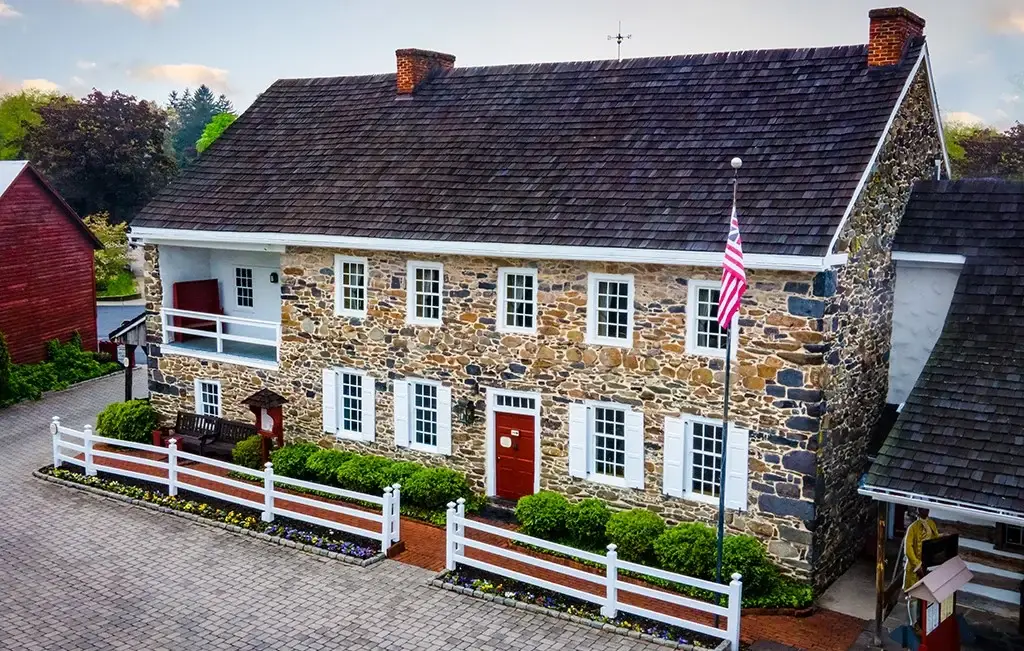
The broad stone front of Dobbin House. Photograph from the house’s own collection.
Stone & proportion
A substantial stone dwelling, organized across a broad, seven-bay front.
A working house
Fireplaces, a spring and spaces for daily life connect architecture with use.
03 / Faith, books & education
A home for
the life of the mind.
Dobbin taught in his own house. That fact changes how we read the rooms: they were places for study and instruction as well as meals, worship and family life. The classical school combined the demands of learning with the realities of a household.
McJimsey explains that the need to educate a large family helped prompt Dobbin to open a private boarding school. He particularly remembered Dobbin’s command of Latin, Greek and Hebrew. In this educational tradition, language study was central to reading ancient texts and preparing for learned professions and the ministry.
From the collection
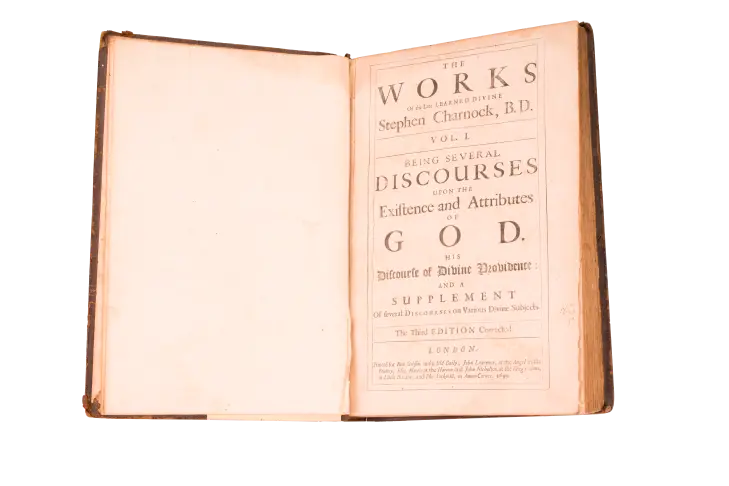
A book once owned by Dobbin, printed in 1699 and acquired in 1791. Collection of Gettysburg History / Beyond the Battle Museum.
From this household, education reached well beyond the family. Glasgow remembered pupils who entered professional life and the ministry. McJimsey described students choosing Dobbin for theological instruction before a formal seminary took over that role. Learning here depended on the knowledge and personal guidance of the teacher.
There is an unusually direct connection with that intellectual life in Gettysburg History’s collection: a book the museum identifies as Dobbin’s own, printed in London in 1699 and acquired by him in 1791. The open volume pictured here gives the story a physical scale. It was already nearly a century old when he obtained it.
Letters preserved in Sprague’s Annals also make the teacher a less distant figure. McJimsey remembered a strong speaking voice, cheerful company and a man willing to join others in games. These are recollections, written after his death, but they add a human counterpoint to the public offices and formal religious histories.
Dobbin died in 1809. His teaching belonged to a period before modern school and seminary systems took their familiar form. The house is significant partly because it preserves the setting of that earlier, more personal relationship between teacher, students, family and congregation.
04 / The Civil War reaches the town
Gettysburg,
1863.
By the summer of 1863, the house was already eighty-seven years old. The Battle of Gettysburg brought an entirely different scale of violence into a place with a much longer domestic history. The town’s homes, streets and surrounding farms became part of the battlefield and its aftermath.
The house’s published interpretation identifies the Zeigler family as residents during the battle and describes the building’s later use as a hospital. These accounts bring the story back to occupants and wounded people, rather than treating the surviving structure as scenery around a famous military event.
An important later witness is Glasgow. Visiting in 1888, he described an embedded bullet, damage to exterior stone and marks on the west wall that he associated with the fighting. His testimony records how the building was being read twenty-five years after the battle. It should not be mistaken for a modern condition survey.
The map beside this chapter was published in 1864, depicting the July 1863 battle. Roads converge on the town; Cemetery Hill and the surrounding high ground reveal how closely everyday Gettysburg lay beside the fighting. The map offers geographic context for a story experienced in houses and streets as well as on military lines.
That November, Lincoln delivered the Gettysburg Address at the dedication of the soldiers’ cemetery nearby. His return to the Declaration’s language of equality connected the nation’s founding with the cost and purpose of the war. The house, already old by then, belongs to that wider landscape of memory.
The town & the battlefield · 1864 map
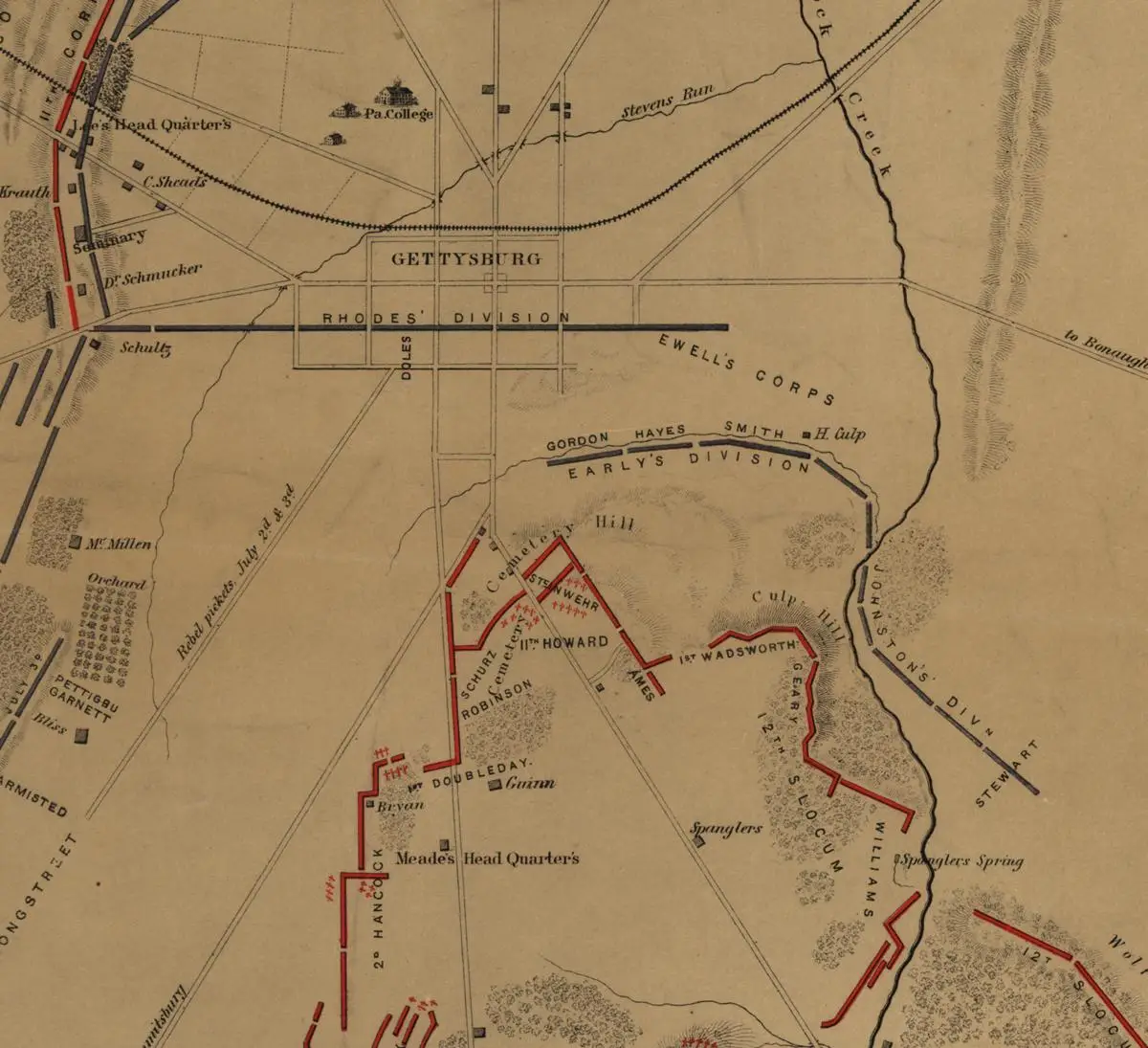
Gettysburg and Cemetery Hill · detail of an 1864 map published by J. B. Lippincott, depicting the July 1863 battle. Library of Congress, Geography and Map Division. The house is not individually identified.
A story that asks care
Freedom seekers
& the historical record.
The house’s interpretation associates a concealed space with people escaping slavery through the Underground Railroad. That association is part of the visitor experience, and it deserves serious attention rather than a decorative legend.
The physical space, the house’s account of its use, and the surviving documentary evidence are different kinds of information. The sources reviewed for this page do not establish named freedom seekers, dates of refuge or a documented sequence of journeys through this building. The account is therefore presented as the house’s interpretation, not as a fully reconstructed episode.
The broader history concerns people seeking freedom under grave risk and the networks that assisted them. It should be told with those people at its center, while remaining honest about what this particular site’s record can and cannot yet show.
05 / The twentieth century & beyond
Preserved.
And put to use.
In 1888, Glasgow found the house still serving as a dwelling: he named Henry Heck as its owner and Catherine Johns as its occupant. The building continued to change hands and uses. By the twentieth century, its story included a Civil War diorama museum, part of Gettysburg’s growing culture of tourism and remembrance.
National Register recognition followed in 1973. The listing acknowledges the historic property; it should not be confused with the separate designation of a National Historic Landmark. Recognition is one moment in preservation, while keeping a building useful and cared for is an ongoing task.
Gettysburg History credits Jackie White with extensive restoration beginning in the late 1970s. The modern restaurant and tavern opened in 1978. This is a comparatively recent chapter in a much older house: today’s hospitality carries the building forward, rather than demonstrating an unbroken tavern business dating to 1776.
The Square added another public expression of that care in 2026. A visitor can now move between an old dwelling and an outdoor place for reading and reflection. The relationship is fitting: education, public life and gathering have all been part of the house’s story, though their forms have changed.
That continuing use is the most useful way to understand the place today. It is neither a frozen household nor a stage on which every detail is original. It is a historic building with a long, layered life—and a present welcome that makes another encounter with the past possible.
The long view
A house through
the years.
The dates place the chapters in order. The rooms, the people and the continuing uses give them meaning.
1774
A life taking root
Dobbin’s work with the Rock Creek congregation and acquisition of land set the scene for a new home.
1776
The stone house
The house is built in the same year the Declaration of Independence is adopted.
1780s–1809
Teaching & ministry
The home becomes a setting for classical and theological education. Dobbin dies in 1809.
1863
War reaches Gettysburg
The battle and its aftermath become another chapter in the house’s interpretation.
1973 / 1978
Recognition & a new use
National Register listing is followed by the modern tavern chapter.
2026
A milestone & the Square
The 250th anniversary connects the historic house with a new outdoor museum.
The story is a place you can visit
A closer look.
A little more time.
Step inside the house.
A guided encounter with the rooms, objects and people behind the story.
Continue in the open.
Founding documents and a commemorative bell beside the historic house.
Revisit a milestone.
The house’s 250th year and the new chapter it helped create.
Keep exploring
Sources &
further reading.
This account brings together archival records, local historical collections and the house’s published interpretation. Source notes distinguish documented events from site tradition.
Sprague’s Annals, 1869 — Volume IX, pages 27–31, including John McJimsey’s 1818 reminiscence of Dobbin and a later recollection by James M. Mathews.
Glasgow’s 1888 history — Alexander Dobbin biography, original pages 481–483; the historical text is reproduced in a later digital edition.
An 1888 visit to the house — W. M. Glasgow, “Covenanters at Gettysburg,” October 1888, pages 347–352. A firsthand inspection, with period interpretations that require care.
National Register record — National Park Service record for Dobbin House, NRIS 73001584, listed March 26, 1973.
The house’s historical account — Dobbin House’s own interpretation. Used with attribution where independent evidence remains incomplete.
Gettysburg History’s collection — The museum identifies a surviving book owned by Dobbin, printed in 1699 and acquired in 1791. Photograph reproduction rights remain to be cleared.
Gettysburg History on Jackie White — The historical organization’s account of White’s restoration and preservation work.
Library of Congress map — J. B. Lippincott’s 1864 map of the July 1863 battle, from Michael Jacobs’s Notes on the rebel invasion. Geographic context, not a verified house-location pin.
The 2026 project announcement — The operator’s account of the modern restaurant’s 1978 opening and the plans for the Square.